


We Compared 50 Affordable Hearing Amplifiers: KifTech’s Top 2 Picks for South Africa
KifTechKIFTECH BUYER’S GUIDE · Updated 4 September 2026 · 12-minute read
Choosing a hearing amplifier can get confusing quickly. Many models look similar, yet the details that shape daily use - fit, controls, charging and feedback - can be very different.
We compared 50 affordable hearing amplifiers shortlisted for KifTech. We checked their published features, available technical details, review history and 51 buyer comments, then scored every model against the same practical criteria.
Two stood out for different reasons. The GM-903 is our pick for Bluetooth calls and connected use. The rechargeable behind-the-ear model is our pick for straightforward controls and easier day-to-day handling.
To keep this comparison honest, we based it on published product information and third-party buyer feedback. We have not presented those comments as KifTech customer reviews. This guide is not a clinical assessment, and a hearing professional can help if your hearing has changed or you are unsure what level of support you need.
The short answer
Choose the GM-903 if Bluetooth phone calls, independent left/right units and a visible charging display matter most. Choose the behind-the-ear 144-hour model if simple physical controls, long stated endurance and an easier-to-handle form are the priority.
| What matters | GM-903 | Behind-the-ear 144h model |
|---|---|---|
| Best for | Bluetooth calls and connected use | Simple controls and everyday wear |
| Form | Two black in-ear units with display case | Two silver behind-the-ear units with charging case |
| Connectivity | Bluetooth 5.0; published specifications say either unit can connect independently | No Bluetooth stated |
| Controls | One-key play, pause and call control | Sliding volume wheel and one-button mode switching |
| Sound tools | Digital processing, stated noise reduction and whistle suppression | Stated noise and wind reduction; two modes noted in buyer feedback |
| Power | Manufacturer states 35 hours per charge plus up to 300 hours through the case | Manufacturer states 48 hours per charge and 144 hours total through the case |
| Review evidence | 4.6/5 from 3 published buyer reviews; 2,070 units reported sold | 5.0/5 from 1 published buyer review; 223 units reported sold |
| Most useful review signal | Bluetooth calling worked well; insertion was easy; correct fit mattered for feedback | Easy adjustment and strong battery feedback; very noisy environments remained challenging |
| Main caution | Only three published reviews, and one buyer reported feedback when the fit was wrong | Only one published review; no Bluetooth; real battery life may vary |
How we compared the top 50
A high rating did not win on its own. Some older products had collected more reviews simply because they had been available for longer. That history matters, but it does not tell you whether the controls, charging setup or fit will suit your routine.
We scored every model in six areas. Comments about sound, fit, controls and battery counted more than delivery-only feedback. Where a feature or battery figure came from a product specification rather than hands-on testing, we treated it as a stated claim.
- Review quality — 25%: Rating, review volume, reported sales and whether buyers discussed sound, fit, controls, battery or everyday use.
- Sound features — 25%: Digital processing, noise reduction, feedback control, listening modes and the clarity of the acoustic information.
- Battery and charging — 15%: Rechargeability, charging case, connector and stated listening time.
- Ease of use and fit — 15%: Control design, display, ear-tip options, portability and what buyers said about handling.
- Everyday value — 10%: Whether the feature set makes sense for the product's expected price and use case.
- Information quality — 10%: How complete and consistent the published product information appeared.
Research based on published product information and 51 third-party buyer comments across 50 shortlisted models, reviewed 3 September 2026.
Top pick #1: GM-903 — best for Bluetooth and connected use
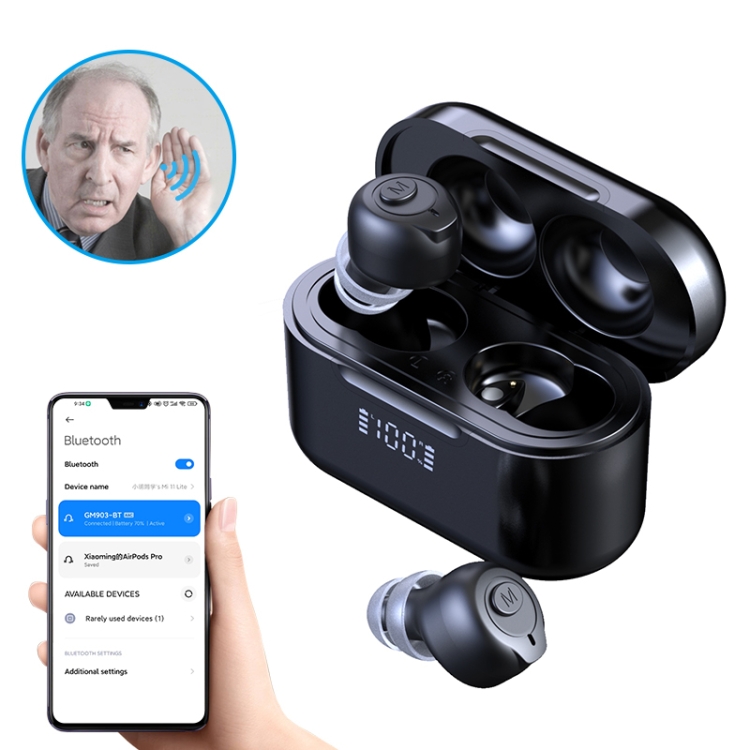
Of the 50 models we compared, the GM-903 offered the strongest mix of connected features and useful buyer feedback. It held a published rating of 4.6 out of 5 from three reviews, with 2,070 units reported sold when we completed our research.
Bluetooth 5.0 is what sets it apart. The two earpieces can connect independently, so you can wear one or both. A single button handles playback and calls, while the case display shows the remaining power for the case and each earpiece. Magnetic docking and USB-C charging keep the setup familiar.
The manufacturer states up to 35 hours of listening per charge and up to 300 hours through the case, with a two-hour charging time. Treat that as a guide rather than a promise. Call time, Bluetooth use, volume and charging habits will affect the result.
The review pool is small, but the comments tell us more than a star rating alone. One buyer liked the amplification, Bluetooth performance and easy insertion, while noting that poor positioning could cause feedback. Another called out phone-call performance as a strength.
Why it made the top two
- It has the strongest connectivity package in our shortlist.
- Digital processing, noise reduction and whistle suppression are all listed.
- The power display lets you check the case and both earpieces at a glance.
- Buyer comments covered Bluetooth, calls, fit and feedback rather than delivery alone.
What to know before buying
- Getting the ear-tip size and position right appears important for limiting feedback.
- Three public reviews are useful, but still a small sample.
- Battery figures are manufacturer-stated and real-world runtime will depend on how you use the device.
Top pick #2: behind-the-ear 144h model — best for simple daily wear
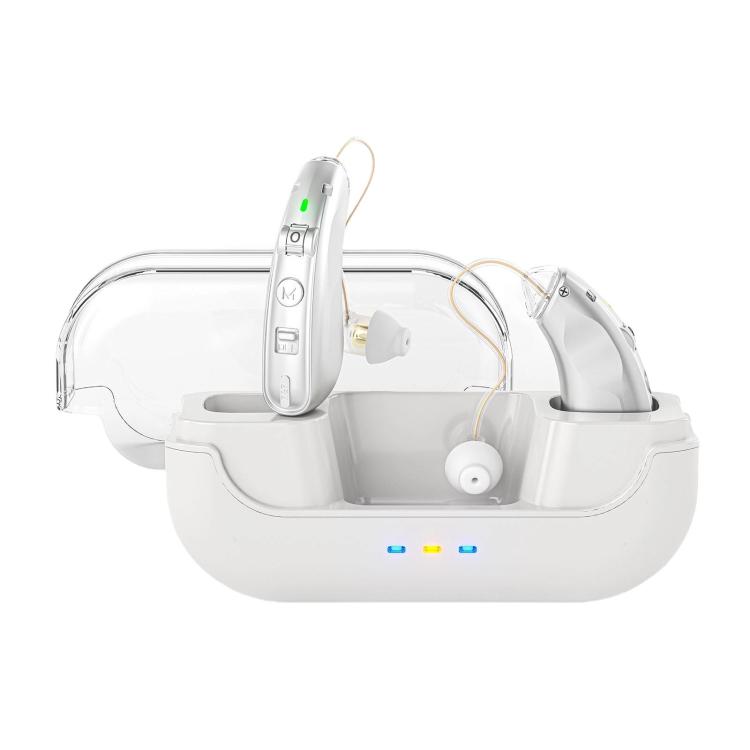
Our second pick takes a more traditional approach. It sits behind the ear and uses physical controls, making it the better choice when easy handling matters more than Bluetooth. It had one published five-star review and 223 units reported sold when we completed the comparison.
A sliding volume wheel lets you make gradual changes, and one button switches between listening modes. That may feel easier than touch gestures or tiny in-ear dials. The product also includes soft ear tips, a magnetic charging case and stated noise and wind reduction.
The manufacturer states up to 48 hours per charge and up to 144 hours in total through the case. Its published technical sheet also includes gain, input-noise and frequency figures, which gives shoppers more information than many budget models provide. Those figures still cannot predict comfort or sound quality for every ear.
There is only one detailed buyer review, but it covers the things that matter. The buyer liked the build, adjustable amplification, two listening programmes and battery life. The same person said very noisy settings remained difficult, which is a useful reminder that noise reduction is not noise removal.
Why it made the top two
- Physical volume wheel and one-button mode switching.
- Long, clearly explained manufacturer-stated battery life.
- Behind-the-ear form may be easier to handle than very small in-ear units.
- The available review covers sound adjustment, listening modes, noise and battery life in useful detail.
What to know before buying
- The review pool is only one person, so there is limited long-term feedback.
- No Bluetooth capability is stated.
- Very noisy settings may still be challenging, even with noise reduction switched on.
View the behind-the-ear model on KifTech
Why the feedback-count leaders did not automatically win
The S-HA-0101 had 67 published reviews and 22,500 units reported sold. The AXON K-188 had 19 reviews and 17,066 units reported sold. That track record deserves attention, but both products offer a more basic feature set and older power options than our finalists.
The rechargeable GM-305 also looked promising. Yet its most useful reviews mentioned repeated feedback and listening fatigue. Several newer multi-channel models had strong specifications but no visible buyer reviews, leaving us with too little real-use context to place them first.
Our final choice balances both sides: enough buyer history to avoid choosing from a specification sheet alone, and enough useful features to make daily use easier.
Four other models worth considering
| Model | Best for | Why it is interesting | Why it did not make the top two |
|---|---|---|---|
|
Z-26D1 TBD0605077701A |
Discreet digital option | Digital processing, touch controls and up to 150 hours stated total use | Only one detailed product-use review, and touch controls will not suit everyone |
|
Z-127D TBD0603391701D |
Compact in-ear alternative | Display case, 30-hour stated use and feedback/noise reduction | Two useful reviews, but one buyer said the earpieces felt a little large |
|
GM-912 TBD0603031001A |
Digital display case | Digital processing, push-button operation and 30-hour stated use | Two published reviews, but little detailed first-person feedback |
|
AXON K-188 HA0001 |
Lower-cost option | 19 published reviews, 17,066 units reported sold and a simple design | It uses disposable A10 batteries and has fewer modern features |
Which of the two should you choose?
Pick the GM-903 when…
- Phone calls are a major use case.
- A visible charging display is reassuring.
- The wearer is comfortable fitting small in-ear units and trying different tips.
- Bluetooth convenience is worth the added pairing and charging steps.
Pick the behind-the-ear model when…
- Physical controls are easier than touch gestures.
- Long stated battery endurance matters more than Bluetooth.
- A behind-the-ear body is easier to handle and keep track of.
- The wearer prefers a straightforward listening device rather than a connected earbud-style product.
How to get a fair first-use comparison
- Start at the lowest volume: Insert or position the unit before increasing volume gradually. This is especially important for reducing sudden loudness and feedback.
- Try every supplied tip: A seal that is too loose can whistle; one that is too tight can become uncomfortable. Left and right ears may need different sizes.
- Test in three real settings: Use a quiet conversation, television and a moderately noisy room. A product that only sounds good in silence may disappoint in daily use.
- Track comfort and charge: Note pressure, fatigue, battery runtime and any feedback during the return window.
If hearing is changing, a professional assessment can help identify the cause and the right level of support. Sudden hearing loss, rapid worsening, ear pain or discharge needs urgent assessment rather than simply more amplification.
The NHS hearing-loss guidance is used here as a general safety reference; South African readers should contact an appropriate local clinician or audiologist.
Frequently asked questions
Which product is KifTech’s best overall pick?
The GM-903 is our best connected pick because Bluetooth calling, independent earpiece use, a power display and relevant buyer feedback give it the broadest everyday use case. The behind-the-ear model is the better choice for simpler controls.
Why does the article say hearing amplifier instead of hearing aid?
A hearing aid is a regulated medical device fitted for a person's hearing needs. We use the broader term hearing amplifier for these products and do not present them as a substitute for a professional hearing assessment.
Can either model remove all background noise?
No. Both products list noise-reduction features, but reduction is not elimination. One buyer of the behind-the-ear model said very noisy settings were still difficult.
Is Bluetooth worth choosing?
Bluetooth is valuable when phone calls and connected audio are important. It also adds pairing and battery complexity, so a non-Bluetooth model with physical controls may be a better fit for some routines.
Is an in-ear or behind-the-ear design better?
Neither is universally better. In-ear designs are discreet, while behind-the-ear designs are often easier to handle and adjust. Ear shape, dexterity, glasses and comfort all affect the choice.
Should I get a hearing assessment first?
If hearing is changing, a qualified hearing professional can assess the cause and recommend an appropriate device. Sudden hearing loss, rapid worsening, ear pain or discharge should be assessed urgently rather than managed by simply increasing amplification.
Are the reviews mentioned here KifTech customer reviews?
No. We used third-party buyer feedback to compare the models. We do not present those comments as verified KifTech purchases or add them to KifTech's customer-review score.
Compare KifTech’s top two
Choose connected convenience or simple daily controls, then check fit, specifications and current availability before ordering.
Explore GM-903Explore the BTE pickHow we researched this guide
- Published specifications and third-party buyer feedback for 50 shortlisted hearing amplifiers.
- GM-903 product page on KifTech.
- Rechargeable behind-the-ear model on KifTech.
- SAHPRA Medical Devices Unit: establishment licensing and medical-device oversight in South Africa.
- NHS hearing-loss guidance: assessment and urgent-warning guidance.
Product specifications, ratings, reported sales and review themes can change. Battery life depends on volume, Bluetooth use and charging habits. Fit and listening experience will vary from person to person.